 +91 98551-63355


.png)







Modern Knee Replacement Surgery in Punjab – AI, Robotics, and Precision Care at Nagpal Robotics
The landscape of knee replacement surgery has been transformed by technology. What was once a procedure entirely dependent on the surgeon's eye and hand is now guided by artificial intelligence, 3D imaging, robotic arms, and computer verification systems. Modern knee replacement surgery at Nagpal Robotics in Bathinda, Punjab brings together every cutting-edge advancement available in orthopedic surgery today — under the expert hands of Dr. Parampreet Singh Nagpal, Punjab's most decorated robotic knee surgeon.
For patients who have heard about "robotic surgery" or "computer-assisted knee replacement" and want to understand what it truly means and how it differs from older techniques — this guide covers it all.
What is Modern Knee Replacement Surgery?
Modern knee replacement combines several technological advances that together deliver significantly better outcomes than the traditional methods of 10–20 years ago:
- Artificial Intelligence Planning: AI algorithms analyze your joint geometry, alignment, and movement patterns to assist in surgical planning
- 3D CT-Based Surgical Maps: Before surgery, a personalized 3D model of your knee is created from CT scan data
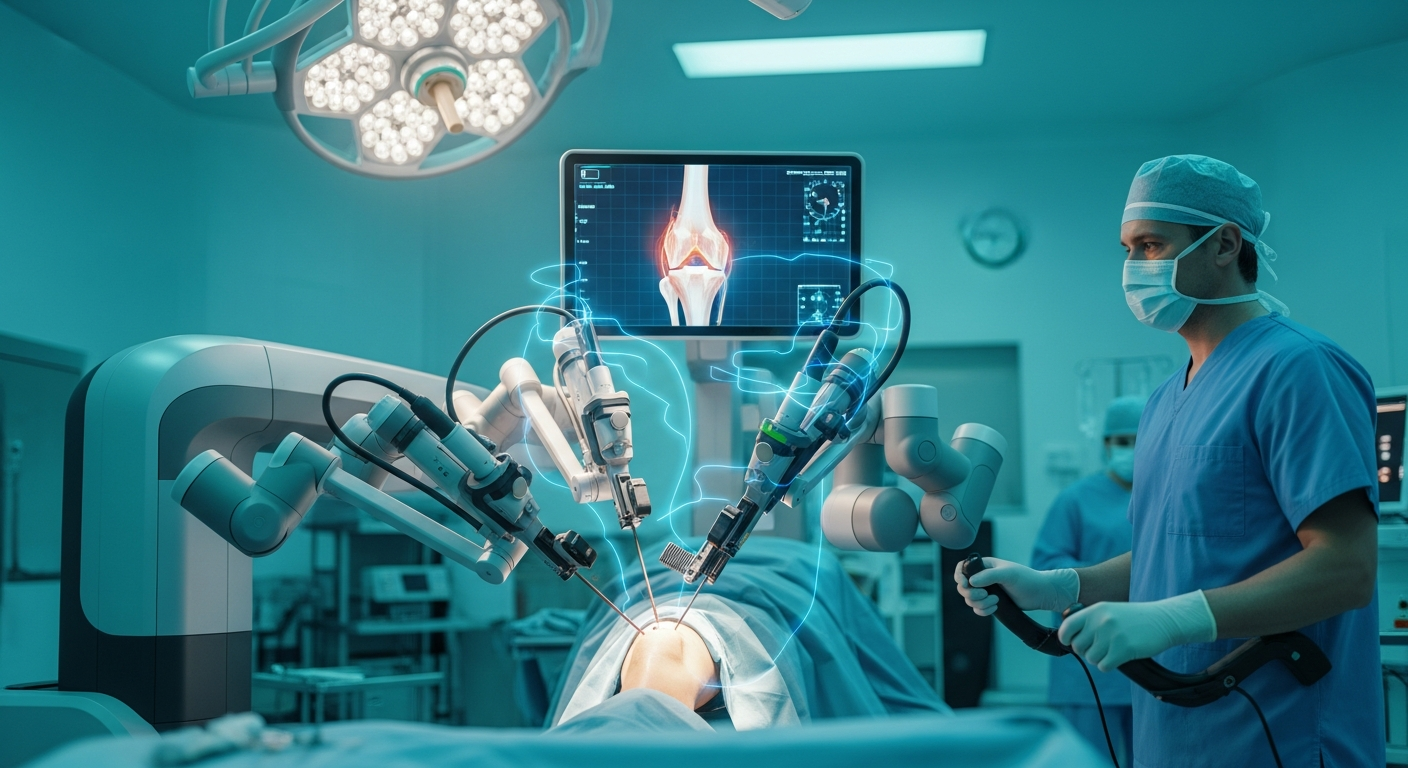
- Robotic-Assisted Execution: Robotic systems guide bone cuts and implant placement with sub-millimetre accuracy
- Real-Time Soft Tissue Monitoring: During surgery, ligament tension is measured dynamically to optimize joint balance
- Computer Verification: After implant placement, digital verification confirms position matches the pre-operative plan exactly
- Advanced Implant Materials: Ceramic, oxidized zirconium, and highly cross-linked polyethylene for superior wear resistance
- Minimally Invasive Approach: Smaller incisions, less muscle disruption, faster healing
The Evolution of Knee Replacement – From Traditional to Modern
Traditional Knee Replacement (1970s–2000s)
In traditional knee replacement, the surgeon uses physical measurement guides, cutting blocks, and experience alone to prepare the bone and place the implant. While highly skilled surgeons achieve excellent results, there is inherent variability — the same surgeon may achieve slightly different alignment on different days.
Computer-Navigated Knee Replacement (2000s–2010s)
Computer navigation added digital guidance to traditional surgery. Sensors tracked the leg's position in real time, giving the surgeon feedback on alignment. An improvement, but the actual bone cutting was still entirely manual.
Modern Robotic Knee Replacement (2010s–Present)
Robotic systems at Nagpal Robotics (CUVIS and CORI) represent the pinnacle of modern knee replacement surgery. The robot not only guides — it actively participates in the surgery, physically limiting motion to protect soft tissue and ensuring every cut follows the pre-planned template exactly. This removes variability from the equation entirely.
CUVIS Joint – Fully Active AI-Powered Robot at Nagpal Robotics
The CUVIS Joint system is the most advanced robotic platform available for knee replacement surgery in Punjab. As a fully active robot, CUVIS autonomously controls the surgical cutting process based on a pre-programmed AI-generated plan, with the surgeon overseeing every movement. Key CUVIS capabilities include:
- Sub-degree alignment accuracy — exceeding what human hands alone can achieve
- Automatic haptic boundary enforcement — the robot stops if it approaches unsafe tissue
- Real-time plan adjustment capability during surgery
- Digital record of every surgical step for quality assurance
CORI Surgical System – Handheld Robotic Precision
The CORI system by Smith & Nephew provides robotic precision in a handheld format. CORI uses imageless technology — it maps the knee in real time during surgery without requiring a pre-operative CT scan. This makes it ideal for specific patient profiles where the CORI approach is more appropriate. Dr. Nagpal is expert with both systems and chooses the most suitable platform for each patient.
Modern Pain Management in Knee Replacement
Alongside surgical technology, pain management in modern knee replacement has also advanced dramatically:
- Periarticular injection: A mixture of local anaesthetic, steroids, and other agents is injected into the knee during surgery, providing hours of post-operative pain relief
- Nerve blocks: Regional anaesthesia techniques numb specific pain pathways for extended relief
- Multimodal analgesia: Combining multiple pain medications that work through different mechanisms reduces reliance on strong opioids
- Tranexamic acid: Reduces surgical blood loss, decreasing post-operative anaemia and the need for blood transfusions
Modern Recovery Protocol – Rapid Recovery After Knee Replacement
Modern "enhanced recovery after surgery" (ERAS) protocols at Nagpal Robotics mean patients recover faster than ever:
- Standing and walking within 4–8 hours of surgery
- Hospital discharge in 3–5 days (vs 7–10 days in older protocols)
- Return to light daily activities within 2–3 weeks
- Full functional recovery in 2–3 months
Why Punjab Patients Choose Modern Robotic Knee Replacement at Nagpal Robotics
The choice is clear when patients compare options:
- Punjab's only dual robotic system centre (CUVIS + CORI)
- An award-winning surgeon with 3,000+ robotic surgeries
- Significantly lower cost than equivalent care in Delhi or Mumbai
- Comprehensive care from first consultation to full recovery
- Accessible location in Bathinda — central to all of Punjab
Frequently Asked Questions
Q. Is modern robotic knee surgery safe?
Yes. Robotic-assisted knee replacement has an excellent safety record. The technology reduces errors and improves consistency. At Nagpal Robotics, complication rates are kept below national averages through meticulous patient selection, sterile technique, and experienced surgical and anesthesia teams.
Q. Does modern robotic surgery mean no physiotherapy is needed?
No. Physiotherapy remains essential even with the most modern surgical techniques. The surgery restores the joint structure; physiotherapy rebuilds the strength, flexibility, and coordination needed for full function.
Q. Is modern knee replacement available for elderly patients?
Absolutely. Modern anaesthesia and surgical techniques make knee replacement safe for patients in their 70s, 80s and beyond, when properly evaluated. Age alone is not a barrier to surgery.
Experience Modern Knee Replacement Surgery in Punjab
AI + Robotics + Expert Surgeon – Nagpal Robotics, Bathinda
Call: +91 98551-63355 Book Appointment