 +91 98551-63355


.png)







Knee Replacement Surgery in Punjab – Everything You Need to Know
Knee replacement surgery is one of the most transformative procedures in modern medicine. For patients who have been suffering from chronic knee pain — whether from arthritis, injury, or joint degeneration — knee replacement surgery restores mobility, eliminates pain, and dramatically improves quality of life. At Nagpal Robotics in Bathinda, Punjab, Dr. Parampreet Singh Nagpal has performed over 3,000 robotic knee replacement surgeries with outstanding outcomes.
This comprehensive guide covers everything you need to know about knee replacement surgery — what it is, who needs it, how it is performed, what recovery involves, and why robotic surgery at Nagpal Robotics in Bathinda is the best choice for patients across Punjab.
What is Knee Replacement Surgery?
Knee replacement surgery — medically known as knee arthroplasty — involves removing the damaged surfaces of the knee joint and replacing them with artificial components made of metal, plastic, and ceramic. These components recreate the smooth gliding surfaces of a healthy knee, eliminating the bone-on-bone grinding that causes pain in arthritic knees.
The surgery does not remove the entire knee. The bones (femur and tibia) remain; only their damaged surfaces are resurfaced. The muscles, tendons, and ligaments around the knee are largely preserved, especially with modern minimally invasive and robotic techniques.
Types of Knee Replacement Surgery
Total Knee Replacement (TKR)
All three compartments of the knee are resurfaced — the medial, lateral, and patellofemoral compartments. This is the most commonly performed type and is appropriate for patients with widespread arthritis throughout the joint.
Partial Knee Replacement (UKR)
Only the damaged compartment is replaced, preserving healthy bone and tissue. Suitable for patients with arthritis confined to one area of the knee. Partial replacement offers faster recovery and a more natural knee feel.
Bilateral Knee Replacement
Both knees are replaced in a single surgical session. Suitable for selected patients with advanced arthritis in both knees. Reduces total recovery time compared to two separate procedures.
Revision Knee Replacement
Performed when a previous knee replacement has failed — due to infection, loosening, wear, or misalignment. More complex than primary replacement, requiring specialist expertise.
Who Needs Knee Replacement Surgery?
Knee replacement surgery is recommended when:
- Knee arthritis is severe (Grade 3 or 4 on X-ray — bone-on-bone contact)
- Pain significantly limits walking, stair climbing, or daily activities
- Non-surgical treatments (medication, physiotherapy, injections) have failed to provide lasting relief
- The knee has visible deformity or bowing
- Pain continues even at rest or disrupts sleep
- Quality of life is significantly impacted by knee pain
Age alone is not a criterion. Patients from their 40s to their 90s can successfully undergo knee replacement when medically appropriate.
Robotic Knee Replacement Surgery at Nagpal Robotics
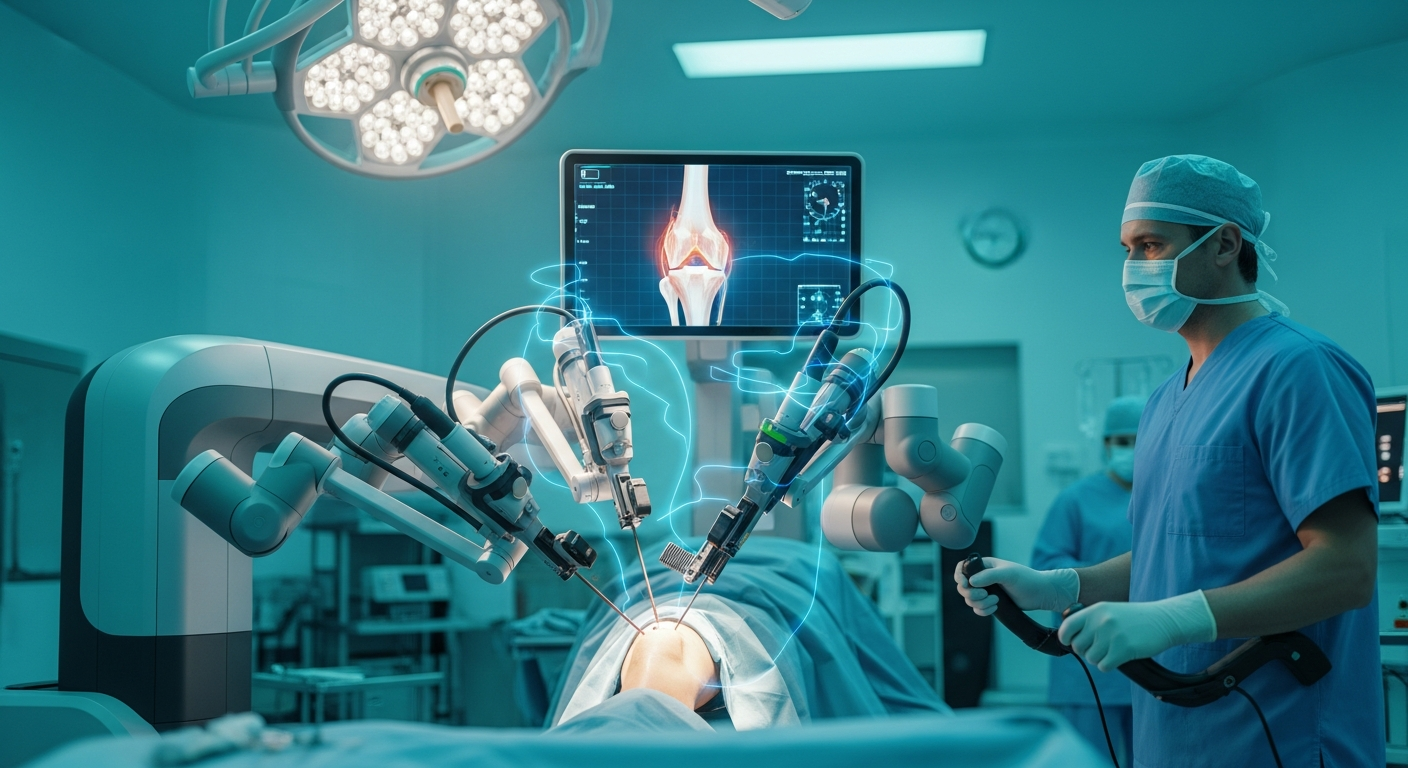
At Nagpal Robotics in Bathinda, all knee replacement surgeries are performed with robotic assistance — using either the CUVIS (fully active robot) or CORI (handheld robotic system) platform. Robotic surgery offers:
- Sub-millimetre alignment accuracy through 3D pre-operative planning
- Real-time feedback and haptic boundaries protecting soft tissue
- Intraoperative verification of implant position
- Personalized surgery based on each patient's unique anatomy
- Faster recovery and better long-term outcomes
Knee Replacement Surgery – Step by Step at Nagpal Robotics
- Consultation: Dr. Nagpal evaluates your knee through examination and imaging
- 3D Surgical Planning: CT scan data creates your personalized robotic surgical plan
- Surgery Day: Anaesthesia administered; 60–90 minute robotic-guided procedure
- Hospital Stay: 3–5 days with physiotherapy beginning day 1
- Recovery: Structured rehabilitation for 3–6 months
Knee Replacement Surgery Cost in Punjab
At Nagpal Robotics, Bathinda:
- Robotic Total Knee Replacement: ₹2.5 lakh – ₹4.5 lakh per knee
- Partial Knee Replacement: ₹2 lakh – ₹3.5 lakh per knee
- Bilateral Knee Replacement: ₹4.5 lakh – ₹8 lakh
Insurance is accepted and the team assists with all documentation. Costs are significantly lower than equivalent metro hospitals.
Risks of Knee Replacement Surgery
As with any surgery, knee replacement carries risks, though complications are uncommon:
- Infection (minimized through prophylactic antibiotics and sterile technique)
- Blood clots (prevented with anticoagulants and early mobilization)
- Implant loosening (reduced through robotic precision alignment)
- Stiffness (prevented through early physiotherapy)
- Nerve or blood vessel injury (rare)
Choosing an experienced surgeon with advanced technology significantly reduces all these risks.
Life After Knee Replacement Surgery
The majority of knee replacement patients describe surgery as life-changing. Common outcomes include:
- Walking long distances without pain
- Climbing stairs comfortably
- Sleeping through the night without knee pain
- Returning to work and social activities
- Swimming, cycling, and light exercise
Frequently Asked Questions
Q. Is knee replacement surgery permanent?
Modern knee implants last 15–25 years. Most patients do not require revision surgery. Maintaining healthy weight and following activity guidelines maximizes implant longevity.
Q. Can knee replacement surgery be avoided?
In earlier stages of arthritis, yes — physiotherapy, medication, injections, and lifestyle changes can delay surgery. However, once arthritis reaches Grade 3–4 with bone-on-bone contact, surgery is generally the only effective treatment.
Q. Is knee replacement surgery painful?
The surgery itself is performed under anaesthesia — there is no pain during the procedure. Post-operative pain is effectively managed with modern multimodal pain protocols. Most patients find recovery much less painful than expected.
Q. What is the best age for knee replacement surgery?
There is no "best" age. Surgery is indicated when arthritis is severe and quality of life is significantly affected. Patients from age 45 to 90+ have successfully undergone knee replacement at Nagpal Robotics.
Ready for Knee Replacement Surgery in Punjab?
Consult Dr. Parampreet Singh Nagpal – Nagpal Robotics, Bathinda
Call: +91 98551-63355 Book Appointment