 +91 98551-63355


.png)







Minimally Invasive Knee Replacement Surgery in Punjab – Less Pain, Faster Recovery
For patients who have been postponing knee replacement surgery out of fear of large incisions, prolonged hospital stays, and painful recovery — minimally invasive knee replacement surgery offers a modern answer. At Nagpal Robotics in Bathinda, Punjab, Dr. Parampreet Singh Nagpal combines minimally invasive techniques with robotic precision to deliver outstanding surgical outcomes with minimal disruption to the patient's body.
Minimally invasive knee replacement (MIS knee replacement) uses smaller incisions and specialized instruments to perform the same surgery as traditional knee replacement — but with significantly less damage to surrounding muscles and soft tissues. The result is less post-operative pain, reduced blood loss, shorter hospital stays, and faster return to daily life.
What is Minimally Invasive Knee Replacement?
In traditional knee replacement surgery, the incision measures 8–12 inches. Minimally invasive techniques reduce this to 4–6 inches. The key difference is not just the smaller incision — it is the approach to the muscles and ligaments surrounding the knee. MIS techniques carefully navigate around these structures rather than cutting through them, preserving tissue integrity and reducing recovery time.
When combined with robotic guidance (as performed at Nagpal Robotics), minimally invasive knee replacement achieves the dual benefits of precision and tissue preservation.
Benefits of Minimally Invasive Knee Replacement
Smaller Scar
Reduced incision size means a smaller, less visible scar on the knee after healing.
Less Blood Loss
Smaller wound and less tissue disruption leads to significantly reduced surgical blood loss.
Less Post-op Pain
Preserving muscles and soft tissue reduces pain after surgery, decreasing dependency on pain medications.
Faster Recovery
Most MIS knee replacement patients walk within 24 hours and return to light activity in weeks, not months.
Shorter Hospital Stay
Many patients are discharged within 2–3 days instead of the 5–7 days typical for traditional surgery.
Reduced Infection Risk
Smaller wound surface area reduces the risk of surgical site infection.
Robotic Assistance in Minimally Invasive Knee Replacement
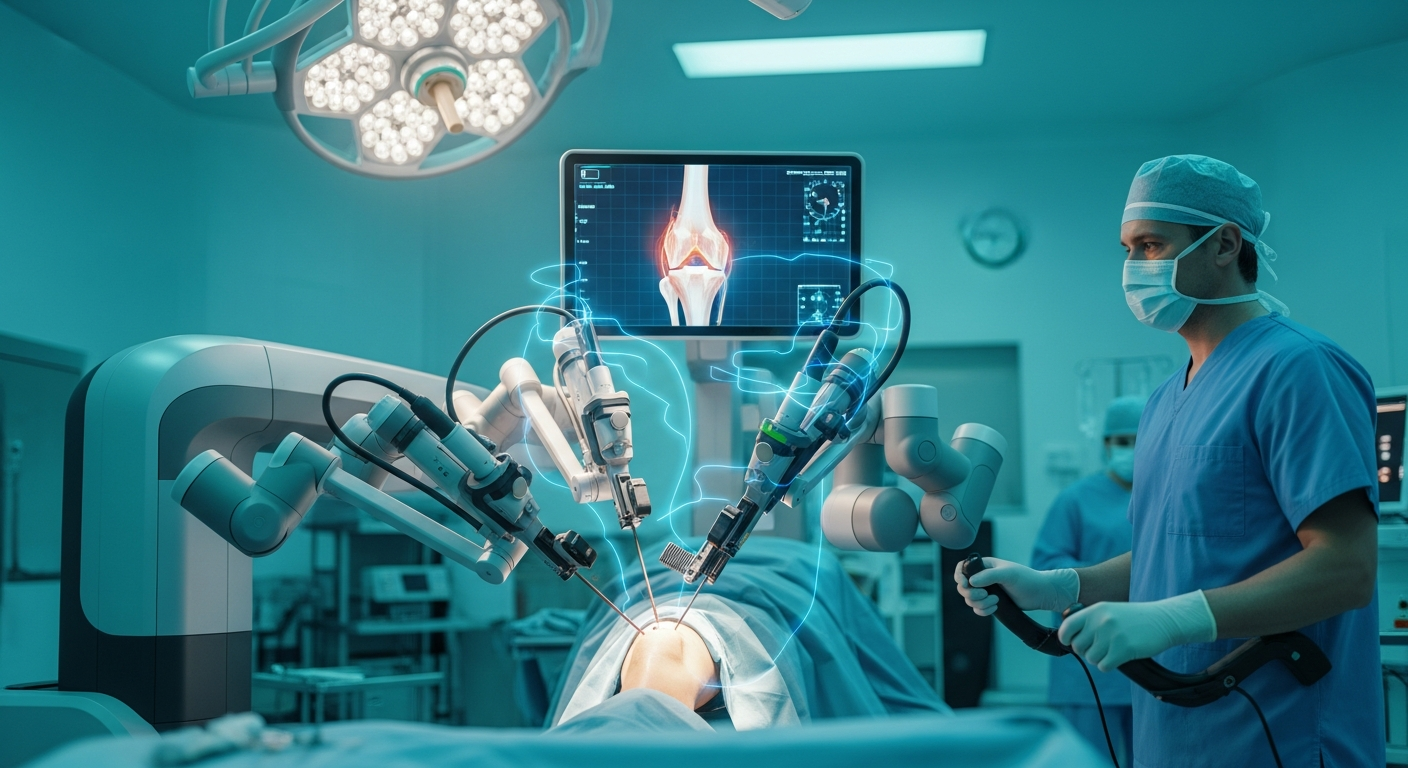
Minimally invasive surgery presents a technical challenge: smaller incisions limit the surgeon's direct visualization of the joint. This is exactly where robotic technology becomes invaluable. At Nagpal Robotics, the CUVIS and CORI robotic systems provide:
- Real-time 3D imaging of the knee joint even through a small incision
- Haptic feedback that prevents inadvertent tissue damage
- Sub-millimetre accuracy in bone cuts without relying on direct visual exposure
- Optimal implant positioning verified before wound closure
The combination of minimally invasive technique and robotic precision represents the gold standard in modern knee replacement surgery.
Who is Suitable for Minimally Invasive Knee Replacement?
MIS knee replacement is suitable for many patients, though not everyone qualifies. Ideal candidates typically have:
- Moderate to severe knee arthritis requiring replacement
- Healthy body weight (obesity can make MIS more difficult)
- No significant knee deformity (severe varus/valgus deformity may require traditional approach)
- Good overall health for surgery and anaesthesia
- Motivation to participate in post-operative physiotherapy
Dr. Nagpal evaluates each patient individually to determine whether MIS is appropriate or whether a traditional approach will deliver better results in their specific case.
Minimally Invasive Knee Replacement Procedure at Nagpal Robotics
Before Surgery
Pre-operative planning includes CT scan analysis for 3D modeling, blood work, anaesthesia assessment, and physiotherapy education. You receive detailed instructions on what to do and avoid in the days before surgery.
During Surgery
A 4–6 cm incision is made over the knee. Robotic guidance enables precise bone preparation and implant placement through this small window. The entire procedure typically takes 60–90 minutes.
After Surgery
Physiotherapy begins within 24 hours. Most patients walk the same day or the next morning. Pain management is effective with modern multimodal protocols. Hospital discharge occurs within 2–4 days for most patients.
Recovery Timeline – Minimally Invasive Knee Replacement
- Day 1: Standing with support, first physiotherapy session
- Day 2–3: Walking with support, discharge preparation
- Week 1–2: Home physiotherapy, wound care
- Week 3–4: Walking without aid for most patients
- Month 1–2: Return to light work and daily activities
- Month 3: Near full recovery, comfortable with stairs and moderate activity
Cost of Minimally Invasive Knee Replacement in Punjab
Minimally invasive robotic knee replacement at Nagpal Robotics is priced at ₹2.5 lakh to ₹4.5 lakh per knee — competitive with traditional surgery costs at larger metro hospitals, with the added benefits of advanced technology. Insurance coverage is accepted and the team assists with all documentation.
Frequently Asked Questions
Q. Is minimally invasive knee replacement as effective as traditional surgery?
When performed by an experienced surgeon with robotic assistance, MIS knee replacement achieves equivalent or better long-term outcomes compared to traditional surgery, with the additional benefit of faster recovery.
Q. Does minimally invasive mean less cutting into the bone?
The bone preparation is similar in extent, but the approach to reach the joint is less disruptive to muscles and soft tissues — that is the key difference.
Q. How long will I be in hospital for MIS knee replacement?
Most patients at Nagpal Robotics are discharged within 2–4 days after minimally invasive robotic knee replacement.
Q. Is minimally invasive knee surgery available for both knees at once?
Bilateral minimally invasive knee replacement is possible in suitable candidates. Dr. Nagpal evaluates fitness and overall health before recommending bilateral surgery.
Book Your Minimally Invasive Knee Replacement Consultation
Advanced robotic MIS knee surgery – Nagpal Robotics, Bathinda
Call: +91 98551-63355 Book Appointment