 +91 98551-63355


.png)





Knee Resurfacing Surgery in Punjab – Expert Care at Nagpal Robotics, Bathinda
Knee resurfacing surgery is a bone-conserving, less invasive alternative to total knee replacement — ideal for patients with moderate knee arthritis who want to eliminate pain and restore an active life without undergoing a full joint replacement. At Nagpal Robotics, Bathinda, Punjab, Dr. Parampreet Singh Nagpal combines expert surgical technique with robotic guidance to deliver outstanding knee resurfacing outcomes for patients across Punjab and beyond.
If you are under 65, moderately active, and suffering from knee arthritis that has not responded to physiotherapy and injections, knee resurfacing surgery in Punjab at Nagpal Robotics may be the ideal solution. This page explains everything you need to know.
Understanding Knee Resurfacing Surgery
The knee joint has three compartments: the medial (inner), lateral (outer), and patellofemoral (kneecap) compartments. In knee arthritis, the cartilage protecting these surfaces wears away, causing bone-on-bone grinding, severe pain, swelling, and loss of mobility.
Knee resurfacing addresses this by replacing only the worn-out surface layer of the affected compartment(s) with precision-fitted metallic and plastic components — similar to how a dentist fits a crown on a damaged tooth. The intact portions of the knee are completely left alone. This means:
- Less bone is removed compared to total knee replacement
- The knee retains more of its natural structure and biomechanics
- Recovery is typically faster and the knee often feels more natural
- If revision surgery is ever needed years later, more bone stock is preserved
Types of Knee Resurfacing Surgery at Nagpal Robotics
Medial Unicompartmental Knee Resurfacing
The most commonly performed type of knee resurfacing. When arthritis is confined to the inner (medial) compartment of the knee — which is the most frequently affected — only that compartment's surface is replaced. The outer compartment and kneecap are left untouched. Patients with medial compartment arthritis and intact cruciate ligaments are ideal candidates.
Lateral Unicompartmental Knee Resurfacing
Less common than medial resurfacing, this procedure addresses isolated lateral (outer) compartment arthritis. It requires careful patient selection as lateral unicompartmental resurfacing is technically more demanding. Dr. Nagpal's expertise ensures excellent outcomes even for this more challenging procedure.
Patellofemoral Resurfacing
When arthritis is isolated to the space between the kneecap and the front of the thigh bone, patellofemoral resurfacing replaces only these two surfaces. Patients with anterior (front) knee pain, clicking, and difficulty with stairs — but without medial or lateral compartment involvement — may benefit from this procedure.
Bicompartmental Knee Resurfacing
When two compartments of the knee are affected, bicompartmental resurfacing replaces both surfaces while preserving the third healthy compartment. This provides more comprehensive relief than unicompartmental resurfacing while still preserving more bone than total knee replacement.
Key Benefits of Knee Resurfacing Surgery
Bone Conservation
Natural Knee Feel
Return to Sports
Faster Recovery
Less Blood Loss
Revisable Later
Robotic Guidance for Knee Resurfacing at Nagpal Robotics
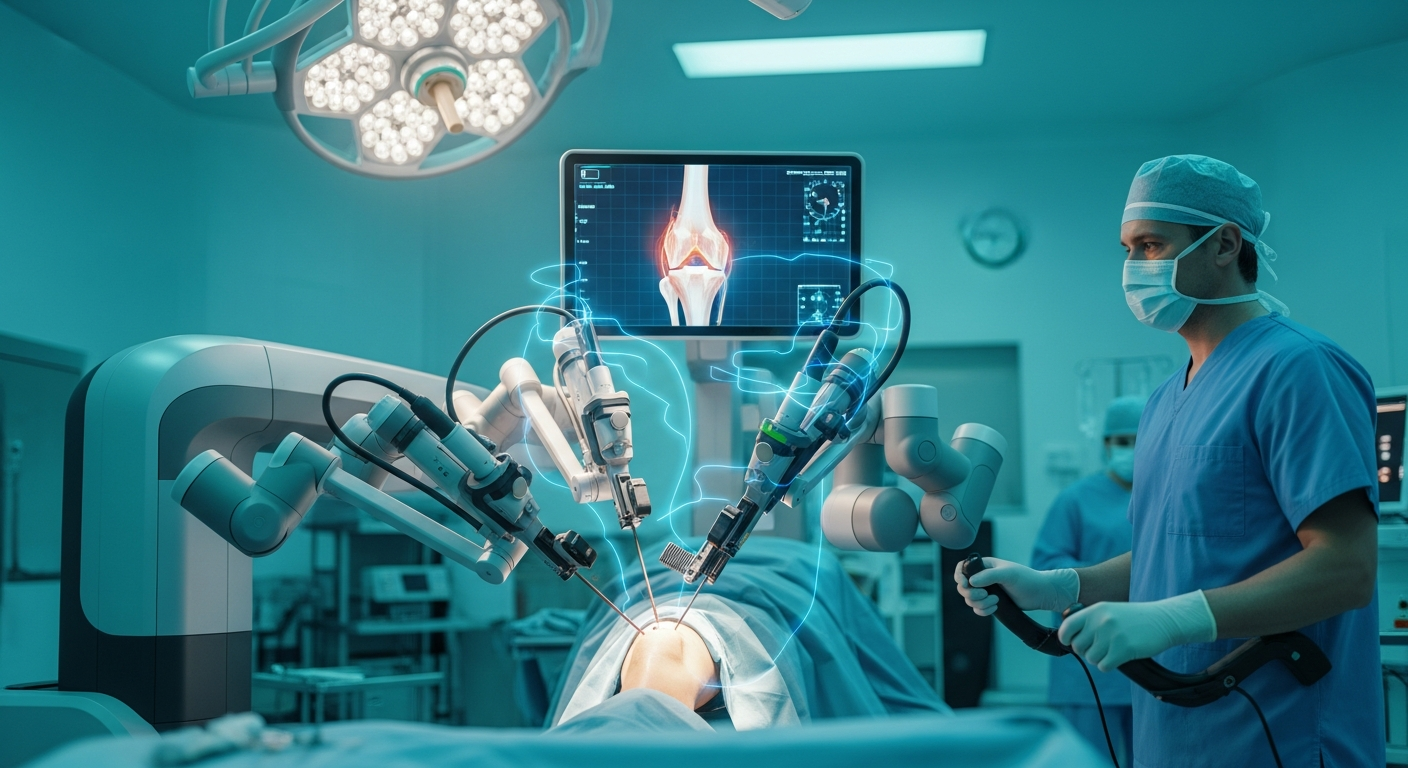
One of the most important factors in knee resurfacing success is precision of implant placement. Even small errors in the angle or depth of bone resection can lead to uneven loading, early implant wear, and poor outcomes. At Nagpal Robotics, Dr. Nagpal uses the CORI robotic system by Smith & Nephew to guide knee resurfacing with real-time haptic feedback — ensuring every bone cut is within the pre-planned boundaries.
This robotic guidance means:
- Each resurfacing component is placed exactly where planned — not where a human hand can estimate
- Joint line and mechanical axis are preserved or corrected precisely
- Soft tissue balance is achieved — equal tension on both sides of the joint
- The risk of under- or over-resection of bone is eliminated
This level of precision translates directly to better long-term outcomes, less implant wear, and longer implant survival.
Who is a Good Candidate for Knee Resurfacing in Punjab?
Dr. Nagpal carefully selects patients for knee resurfacing based on a comprehensive assessment:
- Age 45–65 (may be considered for older or younger patients depending on circumstances)
- Arthritis Grade 2–3 affecting one or two compartments only
- Intact ACL and collateral ligaments — essential for resurfacing stability
- Good bone density (no significant osteoporosis)
- No significant deformity — less than 5-10 degrees of varus or valgus
- Active lifestyle — motivation to return to physical activity
- BMI under 35 — obesity significantly reduces outcomes for resurfacing
- No inflammatory arthritis (rheumatoid arthritis affects multiple compartments and requires total replacement)
The Knee Resurfacing Procedure — Step by Step
Step 1: Consultation
Dr. Nagpal reviews X-rays, examines your knee, assesses your lifestyle and goals, and determines whether resurfacing is appropriate for your specific case.
Step 2: Pre-operative Imaging
MRI or CT scan is taken to assess the extent of cartilage damage and bone quality. The CORI robotic system uses this data to create a personalised surgical plan.
Step 3: Pre-operative Preparation
Blood tests, ECG, anaesthesia consultation, and patient education are completed in the days before surgery at Nagpal Robotics.
Step 4: Surgery
Under spinal or general anaesthesia, Dr. Nagpal makes a small incision and uses the CORI robotic system to guide precise removal of only the damaged surface. The resurfacing components are cemented into place. Surgery takes 45–75 minutes.
Step 5: Recovery
Walking begins within 24 hours. Most patients are discharged in 2–3 days. Full recovery and return to sports in 3–5 months.
Recovery After Knee Resurfacing Surgery in Punjab
- Day 1: Walking with a walker within 24 hours. Light physiotherapy begins.
- Days 2–3: Discharge from Nagpal Robotics with home exercise programme
- Weeks 1–4: Home physiotherapy — range of motion exercises, quad strengthening
- Weeks 4–8: Increasing walking distance. Reduced use of walking aids.
- Months 2–3: Return to daily activities. Light exercise including swimming and cycling.
- Months 3–5: Return to sports (low impact). Most patients fully active by 5 months.
Knee Resurfacing vs Total Knee Replacement — Making the Right Choice
This is the most important question for patients considering knee surgery in Punjab. Here is a clear comparison to help you understand which may be right for you:
- If you are 45–60 with moderate arthritis in one compartment → Knee resurfacing is likely the better choice
- If you are 65+ with severe arthritis in all three compartments → Total knee replacement is the right option
- If you have significant knee deformity (>10 degrees) → Total knee replacement provides better deformity correction
- If you have rheumatoid arthritis → Total knee replacement is needed as all compartments are typically affected
- If you play sports and want to continue → Resurfacing may allow higher activity levels than total replacement
- If you have failed a previous partial knee replacement → Conversion to total knee replacement is appropriate
The final decision is always made together with Dr. Nagpal after a thorough individual assessment. There is no right answer without examining your specific X-rays, clinical findings, and personal goals.
Consult Punjab's Knee Resurfacing Expert
Dr. Parampreet Singh Nagpal – Nagpal Robotics, Mall Road, Bathinda, Punjab
Call: +91 98551-63355 Book AppointmentFrequently Asked Questions
What is knee resurfacing surgery?
Knee resurfacing replaces only the damaged surface layer of the affected knee compartment(s) with thin metallic and plastic implants — preserving the underlying bone, unlike total knee replacement which removes the entire joint end.
Is knee resurfacing available in Punjab?
Yes. Dr. Parampreet Singh Nagpal at Nagpal Robotics, Bathinda performs knee resurfacing surgery using robotic guidance — one of very few surgeons in Punjab with this capability.
How long will I be in hospital for knee resurfacing?
Most patients are discharged within 2–3 days after knee resurfacing at Nagpal Robotics, Bathinda — compared to 3–5 days for total knee replacement.
Can I play sports after knee resurfacing?
Yes. Many patients return to low-impact sports within 3–5 months, and some return to higher-impact activities. Dr. Nagpal will advise based on your specific situation.
What happens if knee resurfacing fails?
In the rare event that resurfacing fails or arthritis progresses to other compartments, it can be revised to a total knee replacement. Because resurfacing preserves bone, this revision surgery is generally straightforward.